SentinelLite AI
A beta-stage defensive Linux endpoint observation and report-review CLI that generates local JSON alert reports and static dashboard views for security learning.
What is this project?
SentinelLite AI is a beta-stage defensive Linux endpoint observation and report-review CLI that generates local JSON alert reports and static dashboard views for security learning. The v1.2.0-beta release adds the local static dashboard milestone, package artifacts, validation workflow, and stronger documentation around safe local usage.
Cybersecurity CLI
2026
v1.2.0-beta
I designed, developed, tested, validated, and released the entire project independently — including the CLI architecture, detection pipeline, scoring engine, report system, static dashboard export, package artifacts, CI/CD workflows, cross-platform validation, and public GitHub pre-release.
What made this difficult?
The main challenge was building a transparent, deterministic detection and scoring pipeline that produces meaningful security insights without relying on external services, cloud APIs, or AI/LLM models. Every detection rule, risk score calculation, and report output needed to be fully explainable and reproducible locally. The v1.2.0-beta release added static dashboard generation and package artifact workflows while preserving this deterministic foundation.
Detection Pipeline
What I Built
Local on-demand Linux endpoint observation CLI
Authentication log analysis
Process and active network connection observation
Selected file integrity checks
Baseline-backed file integrity comparison
Rule-based detection and deterministic risk scoring
Local JSON alert reports
Local report history and review workflow
Deterministic local alert explanations
Static local dashboard export
TOML config/module gating
Package artifacts with SHA256 hashes
GitHub Actions CI with Python 3.11 and 3.14 validation
652 automated tests passed
Testing & Validation
v1.2.0-beta • Public GitHub Pre-release
Not yet published to PyPI. Install from GitHub release artifacts.
Safety Boundaries & Limitations
SentinelLite AI is beta-stage software for local defensive security learning. It is not a production EDR, antivirus, SIEM/SOC platform, malware remover, real AI/LLM-powered system, public scanner, background monitor, exploit tool, or automatic remediation tool.
Project Screenshots
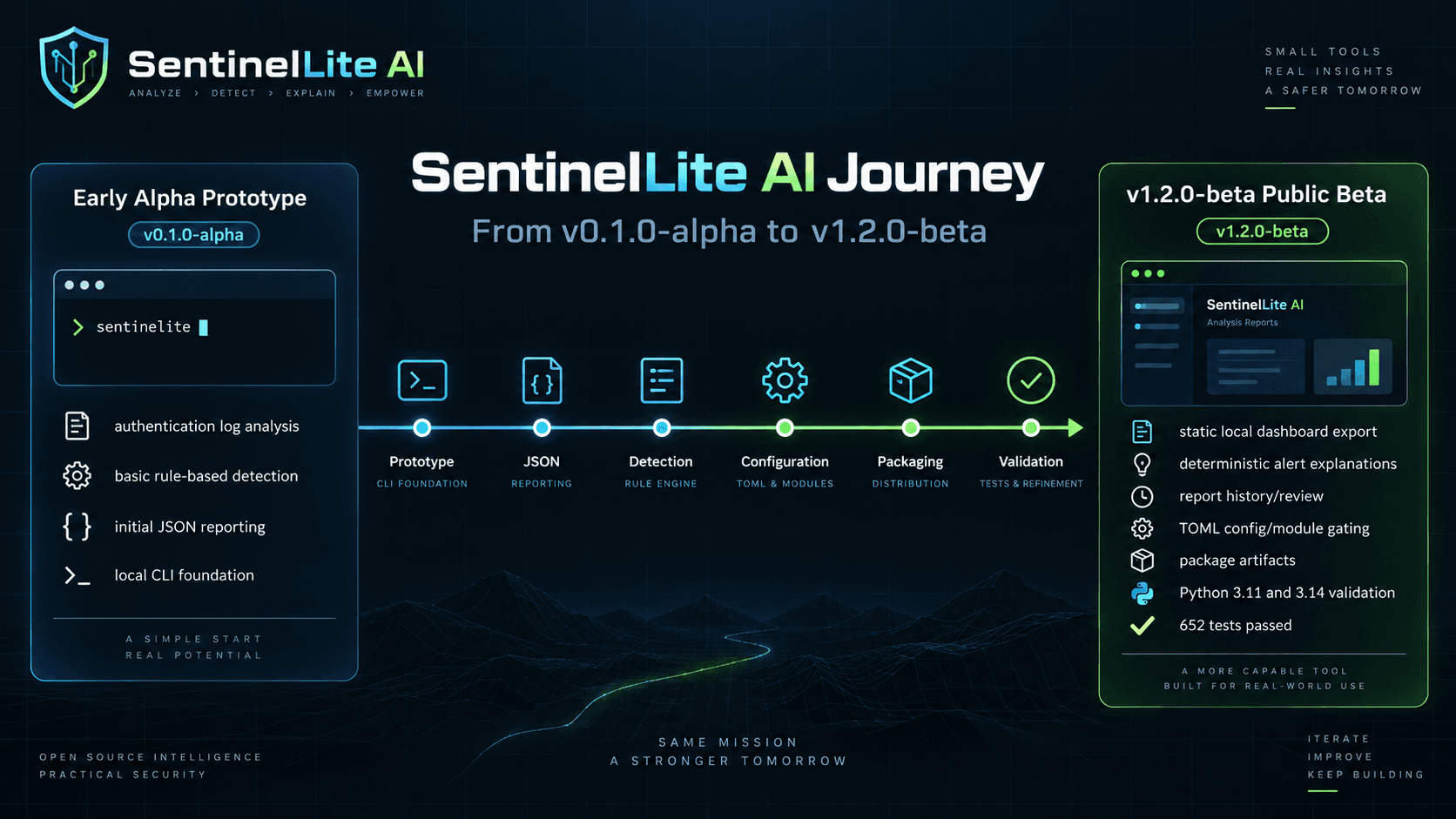
Project Journey — Alpha to v1.2.0-beta
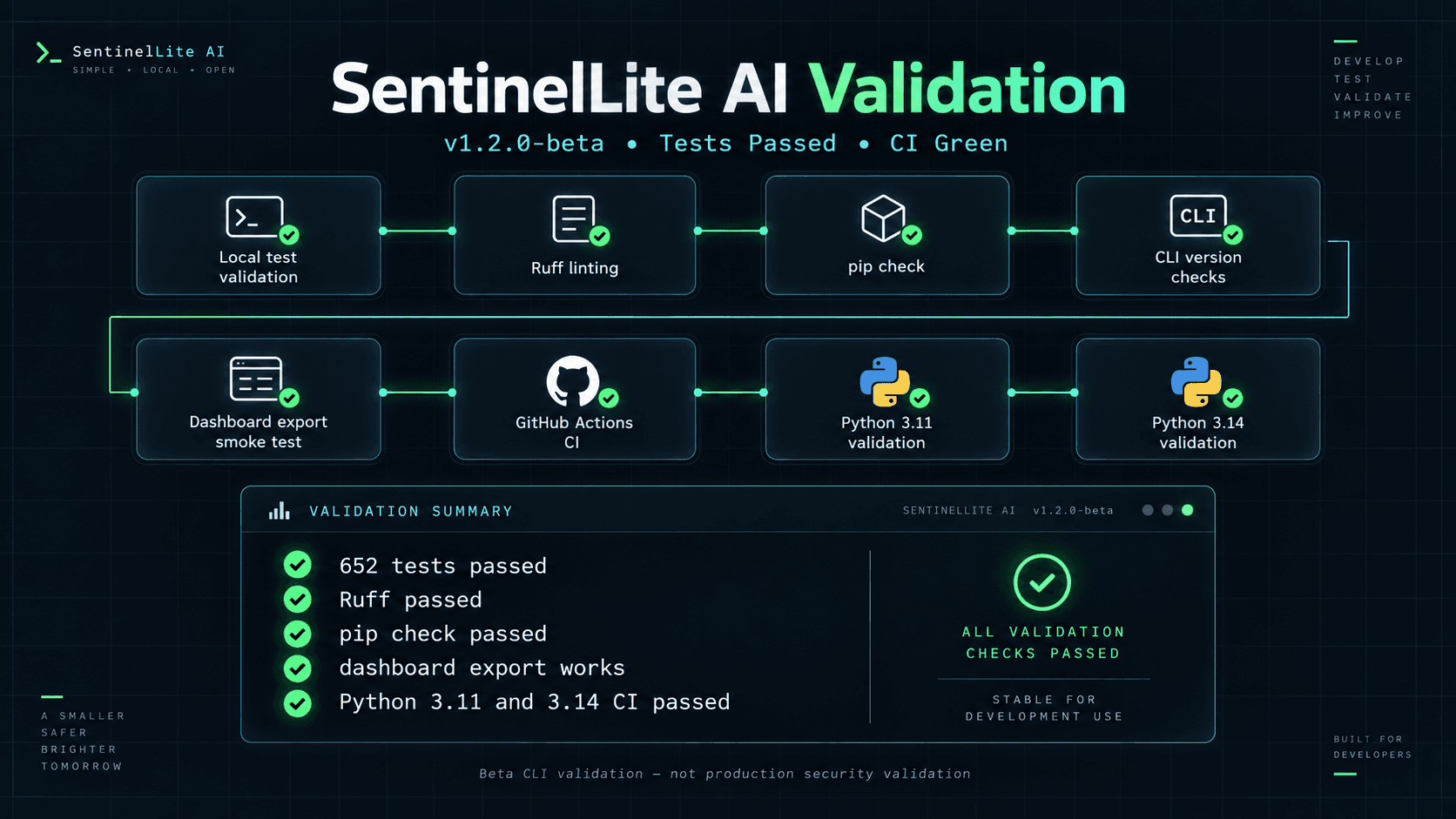
v1.2.0-beta Validation Summary
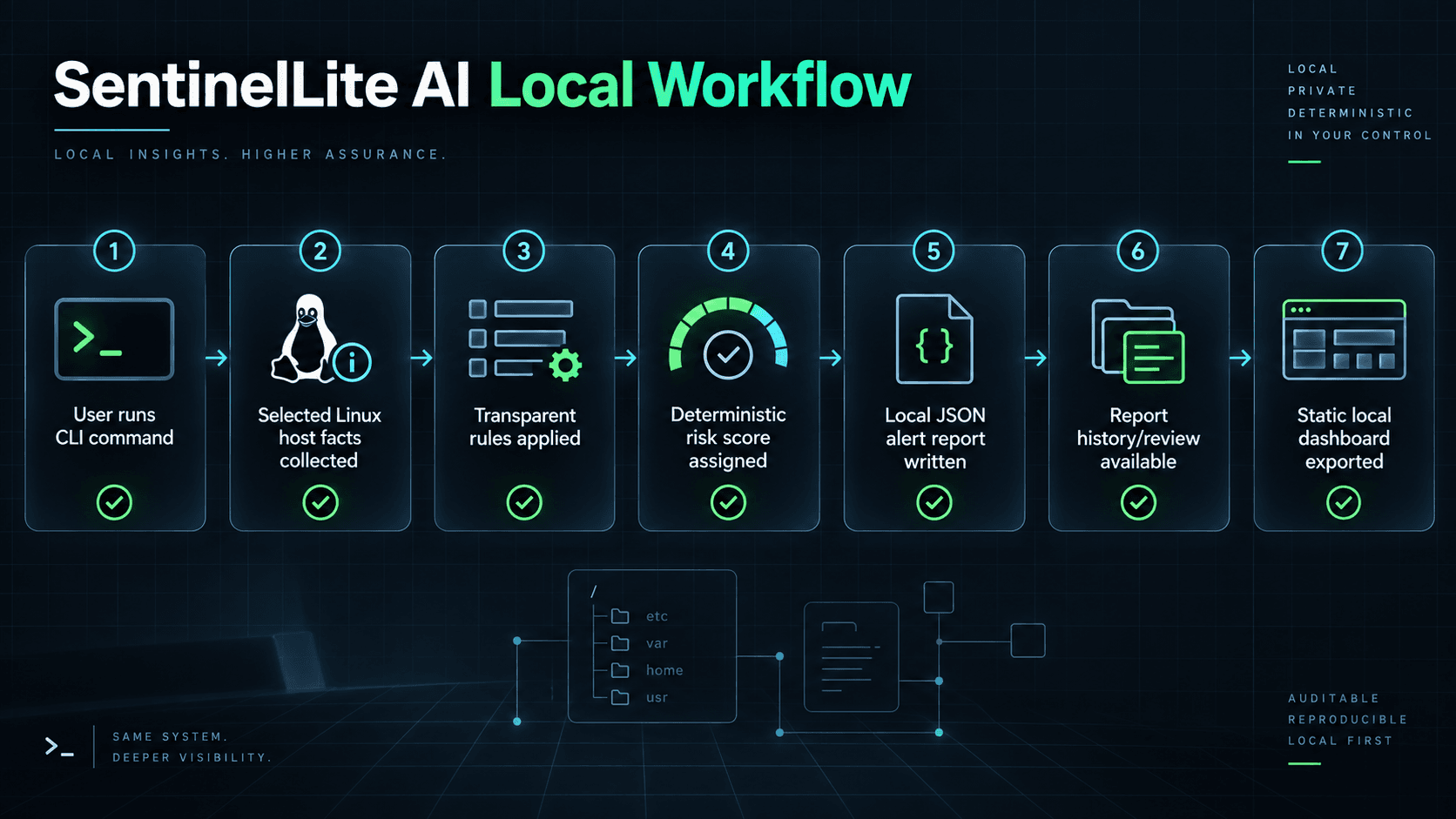
Static Dashboard Export Workflow
What I Learned
SentinelLite AI reached its v1.2.0-beta public pre-release with 652 automated tests passing, full CI/CD validation on Python 3.11 and Python 3.14, static dashboard export, package artifacts with SHA-256 checksums, and a clean GitHub pre-release. It demonstrates practical defensive security engineering concepts, detection pipeline design, static dashboard generation, and disciplined software release practices.